


Essential details
Shipping:Express Delivery
Product Introduction
Main Application
Its main treatment method adopts the biological treatment technology (bio-oxidation method). The integrated domestic sewage treatment equipment is mainly designed for domestic sewage and similar industrial sewage. The water quality parameters of the sewage to be treated are generally in line with domestic sewage quality standards, with BOD5 ≤ 200mg/L.
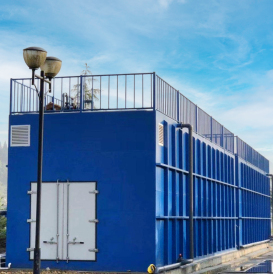
The main components include: 1. Hydrolysis acidification unit; 2. Contact oxidation unit; 3. Sludge sedimentation unit; 4. Disinfection unit; 5. Sludge aerobic oxidation unit.
1. Hydrolysis Acidification Unit
The hydrolysis acidification unit mainly pre-treats the sewage before formal treatment: it performs anaerobic fermentation on the pollutants in the water to improve the biodegradability of the sewage. This is a key step in sewage treatment, as it directly affects the efficiency and duration of subsequent treatment, and can greatly improve treatment efficiency while reducing energy consumption.
2. Contact Oxidation Unit
Contact oxidation units are classified into several grades (standard type and enhanced type) based on the sewage concentration. The type is determined by the treatment duration: the standard type is used for treatment durations ≤ 4 hours, while the enhanced type is used for durations of 4–6 hours.
The effluent from the hydrolysis acidification unit flows directly into the contact oxidation unit for treatment. Most organic matter in the sewage is degraded and mineralized here. Sufficient dissolved oxygen is required, so the organic matter in the sewage serves as the substrate, and the microorganisms in the sewage serve as the material, to achieve the purpose of sewage treatment.
The aerobic air is supplied by a fan. The tank uses a new-type vertical three-dimensional filler, which has a large surface area, long service life, is not easy to agglomerate, and is corrosion-resistant. The bottom of the tank uses a porous aerator to improve the oxygen transfer rate. The filler also has advantages such as light weight, no aging, no clogging, and long service life. The gas-water ratio of the contact oxidation unit is about 12:1 (0.5–5 m³/h per contact oxidation unit).
3. Sludge Sedimentation Unit
After treatment in the contact oxidation unit, the sewage flows into the sedimentation unit to further remove suspended microorganisms, partial organic matter, and small inorganic particles. Sedimentation relies on gravity: when the sewage containing suspended matter flows upward, the matter settles under gravity. The upper part of the sedimentation tank is equipped with a water outlet to adjust the water level, so as to set the sedimentation area and the exhaust gas volume. The gas is supplied by a fan, and the sludge is lifted by a gas lift pump and transported to the sludge aerobic oxidation unit.
4. Disinfection Unit
The disinfection tank complies with the Pollution Discharge Standard of Medical Institutions (GB18466-2005), with a disinfection time of 30 minutes. For hospital sewage, the disinfection time is extended to 1–1.5 hours. Our company uses chlorine dioxide for disinfection. The dosage is adjusted according to the water volume (more dosage for more effluent, less for less effluent). If used for industrial sewage, the disinfection tank and disinfection equipment can be omitted.
5. Sludge Aerobic Oxidation Unit
The sludge aerobic oxidation unit treats the remaining sludge in the sedimentation tank through aerobic oxidation to reduce the sludge volume and improve sludge stability. The amount of sludge after aerobic oxidation is small, and the clear liquid can be directly recycled to the hydrolysis acidification unit. After the sludge in the sedimentation tank is fully aerated, it is transported outward (cleaned once every six months). The clear liquid in the upper part of the sludge aerobic oxidation unit flows back to the hydrolysis acidification unit.